Last Updated: October 22, 2026
Quick Summary
Sometimes. An RV garage can raise your homeowners insurance premium because the structure adds insured value and may require a higher other structures limit, but the garage itself is usually covered as an other structure. The RV inside is typically not fully covered by that policy and needs separate RV coverage.
- Most standard homeowners policies set other structures coverage at a percentage of dwelling coverage, often around 10%.
- An attached RV garage is usually valued with the dwelling, while a detached one gets its own other structures limit.
- Commercial use, rentals, or storing other people’s vehicles can push the building onto a specialty policy.
- Ask your agent to quote the garage and the RV separately so you can see which drives your cost.
- Replacement cost valuation raises premium slightly but prevents a costly shortfall at claim time.
Table of Contents
- Does a Home RV Garage Increase Insurance Premiums? The Short Answer
- Homeowners Insurance Detached Garage Coverage: How the Structure Is Insured
- How an RV Garage Is Classified and Insured
- RV Storage Insurance: Is the Motorhome Itself Covered at Home?
- Insuring a Metal Garage: Steel vs. Wood Construction
- 7 Factors That Raise or Lower Premiums for an RV Garage
- How to Get an Accurate Insurance Quote for Your RV Garage
- Frequently Asked Questions
Does a Home RV Garage Increase Insurance Premiums? The Short Answer
Sometimes. Building an RV garage can raise your homeowners insurance premium, but not for the reason most people assume. The garage itself usually adds a little to your policy. The RV inside it is a separate question entirely, and that second question is where most homeowners get surprised.
Here’s the short version:
- The structure (the garage) is usually covered under your homeowners policy as an “other structure.”
- The RV is often not covered, or only partly covered, by that same policy.
- Your premium impact depends on the structure’s value, your insurer’s rules, and whether you add RV-specific coverage.
Below, we break down how each piece works, what raises or lowers premiums, and the questions to ask your insurer before you build.
An RV garage and the motorhome parked inside it are two separate insurance items. Treat them that way when you budget.
Homeowners Insurance Detached Garage Coverage: How the Structure Is Insured
A detached garage is typically covered under the “other structures” portion of a standard homeowners policy, which protects buildings on your property that aren’t attached to the house, like a shed or workshop (Hurricane Sandy and Insurance: FAQs). The building usually gets some coverage automatically, without a separate policy. But “some coverage” is the key phrase, the limits are often lower than homeowners expect.
Other Structures Coverage and the 10% Rule
Most standard homeowners policies set other structures coverage at a percentage of your dwelling coverage.
Here’s how that plays out in practice:
| Dwelling Coverage | Typical Other Structures Limit (10%) | Enough for a Large RV Garage? |
|---|---|---|
| $250,000 | $25,000 | Often tight |
| $400,000 | $40,000 | Usually workable |
| $600,000 | $60,000 | Comfortable for most builds |
A steel RV garage is a substantial structure. If your other structures limit is low, a total loss could leave you underinsured.
Ask your agent two questions: what is my current other structures limit, and what would it cost to raise it to match replacement cost?
How an RV Garage Is Classified and Insured
Insurers do not have a single “RV garage” category. How the building is classified, and therefore rated, depends on how it is built, what it is used for, and how it is valued.
Most often, a home RV garage falls into one of these buckets:
- Other structure on a homeowners policy. The default for a private, non-commercial garage that is detached from the house. Coverage rides on the same policy as the home, subject to the other structures limit.
- Scheduled structure endorsement. The building is listed separately on the policy with its own limit and its own valuation method. This is common when the garage is unusually large, unusually expensive, or built to a higher specification than a typical detached garage.
- Commercial or specialty policy. Triggered when the building is used for business, when other people’s vehicles or equipment are stored inside, or when space is rented out. A homeowners policy is not designed for those exposures.
Attached vs. Detached Changes the Conversation
An attached RV garage is usually treated as part of the dwelling itself, valued with the house, covered under the dwelling limit, and rated as part of the home’s replacement cost.
A detached RV garage is treated as an other structure, with its own limit, often a percentage of dwelling coverage, and it can be scheduled separately if the default limit is too low.
Use Is the Trigger Insurers Care About Most
Classification follows use more than construction. A private garage that stores your own motorhome is a personal lines exposure. The moment any of the following become true, the file starts looking commercial: Leasing space to others or operating a business out of the structure shifts the risk profile, a transition often accompanied by upgrades like epoxy garage flooring that enhance durability for heavy vehicle traffic.
- You store a neighbor’s, friend’s, or customer’s RV, boat, or trailer for compensation or even as a favor.
- You run a business from the building, such as a repair shop, detailing operation, or fabrication shop.
- You rent bay space to a third party.
Tell your insurer upfront if any of those apply. A claim denied for undisclosed commercial use is an expensive lesson and a common reason large garage claims go sideways.
Valuation Method Matters as Much as Classification
Once the building is classified, the insurer must decide how to pay a claim on it. Two methods dominate:
- Actual cash value (ACV) pays the depreciated value of the structure. On a new steel building, that number can be far below what it costs to rebuild.
- Replacement cost pays to rebuild the structure with like kind and quality, up to the limit (Insurance for Your House and Personal Possessions). For a new red-iron steel RV garage, replacement cost is almost always the better choice.
Ask your agent which method applies and whether you can elect replacement cost. On a steel building with engineered columns, beams, girts, and purlins, the gap between ACV and replacement cost can be substantial after a few years of depreciation.
Classification is not a label on a form. It is the combination of attached or detached construction, personal or commercial use, and ACV or replacement cost valuation. Confirm all three in writing before you build.
RV Storage Insurance: Is the Motorhome Itself Covered at Home?
Usually not fully. This is the part that catches people. Your homeowners policy may extend a small amount of coverage to a recreational vehicle parked on your property, but that coverage is typically limited and often excludes damage that happens while the RV is being driven. A motorhome, travel trailer, or toy hauler is a vehicle, and vehicles generally need their own policy.
Assuming your homeowners policy fully covers a motorhome parked in the driveway is one of the most common and expensive mistakes. Confirm the actual limit in writing before you depend on it.
Lay-Up Coverage and Storage Endorsements
If your RV sits unused for months at a time, ask about lay-up coverage or a storage endorsement. A lay-up policy typically costs less than full coverage because the RV isn’t on the road; the trade-off is that coverage is suspended while the vehicle is in use, so you switch it back on when the season starts. Storage endorsements adjust coverage for a stored vehicle without fully suspending it.
Insuring a Metal Garage: Steel vs. Wood Construction
Construction type affects insuring a metal garage, but usually less than people fear. A well-built steel structure with proper engineering and permits is generally straightforward to insure.
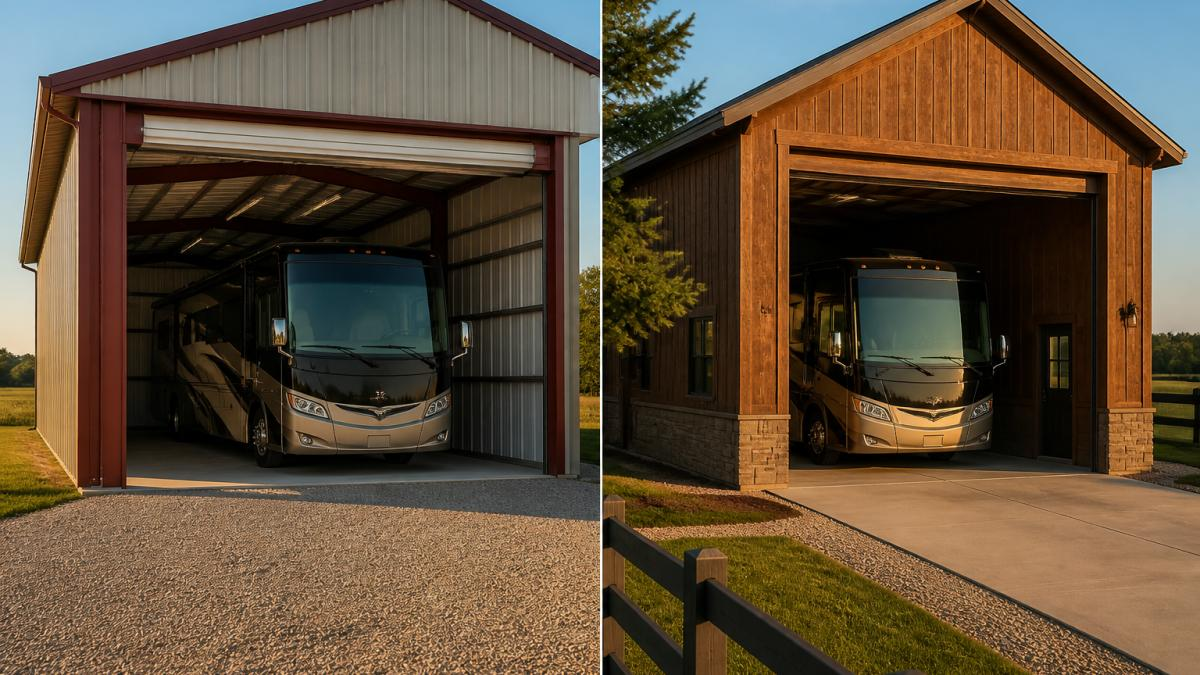
Where insurers focus:
- Engineering and permits. Stamped plans and documented inspections reduce risk questions.
- Roof and wind rating. In high-wind regions, proof of wind-rated construction helps.
- Fire risk. Steel framing doesn’t burn, which some carriers view favorably.
A common mistake is finishing the interior without permits, then discovering the insurer won’t cover the unpermitted work. Pull the permits.
If you’re still choosing a design, our barndominium floor plans include RV garage layouts with wide bays and tall doors, and you can save 10% on eligible stock plans with code STOCKPLANSLUKE.
7 Factors That Raise or Lower Premiums for an RV Garage
No two quotes come out the same, because insurers are pricing two separate exposures at once: the structure and the vehicle. Here are the seven factors that explain most of the difference.
- Structure value and size. A bigger, more expensive building raises the insured value, which raises premium. A modest single-bay garage moves the needle far less than a large multi-bay shop with engineered clear spans, heavy-duty roll-up doors, and finished interior space. Insure the building for what it would actually cost to rebuild, not for what you paid for the kit.
- Other structures limit. Raising your limit to match replacement cost increases premium, but it prevents a painful shortfall at claim time. This is the most common underinsurance problem on detached RV garages. If your default limit is a percentage of dwelling coverage and your steel building is substantial, ask for a scheduled structure endorsement with its own limit.
- Construction type and wind rating. Steel with documented engineering often prices well because the risk is easier to underwrite. Older, non-permitted, or unengineered structures can price poorly or be excluded. In high-wind regions, proof of wind-rated construction, proper anchoring to the foundation, and documented inspections help.
- Fire protection. Proximity to a fire station, a working hydrant, and an on-site water supply can lower rates. The flip side is that a garage used for welding, painting, fuel storage, or other hot work raises fire risk and can push the file toward a specialty policy. Steel framing does not burn, but the contents and the work inside the building do.
- RV value and coverage type. Full coverage on a high-value motorhome costs more than lay-up coverage on a stored unit. This is separate from the garage premium and should be quoted separately. A diesel pusher with a six-figure replacement cost is a different insurance conversation than a modest travel trailer.
- Claims history. A clean record helps. Prior storm, fire, or theft claims on outbuildings can hurt, and some carriers will surcharge or non-renew after a large outbuilding claim. Ask how a garage claim would affect your home policy’s claims history before you file.
- Use of the building. Personal storage prices lowest. Commercial use, rentals, or storing other people’s vehicles pushes you toward a specialty policy. This is the factor most likely to change the policy form entirely, not just the premium.
Ask your agent to quote the garage and the RV separately. Seeing the two numbers side by side tells you which one is actually driving your cost, and that is where to focus. If the garage is the driver, look at the other structures limit and the valuation method. If the RV is the driver, look at the RV policy’s coverage type and deductibles.
Factors That Can Lower the Number
It is worth naming the factors that work in your favor, because the conversation online tends to focus only on surcharges:
- Documented engineering and permits. Stamped plans, inspection records, and a permitted electrical sign-off reduce underwriting questions.
- Wind-rated construction in high-wind regions. Proof of anchoring and rated components helps.
- Fire protection. A nearby station, a hydrant, or an on-site water supply can improve the rate.
What This Means for Your Budget
The practical takeaway is that an RV garage does not carry a universal surcharge. It carries a premium that reflects the structure’s replacement cost, construction and fire risk, and use, plus a separate premium for the RV itself.
If you are still in the planning stage, start with a FREE building quote so you know the structure cost before you insure it. And when you are ready to build, our contractor directory lists metal building specialists by state. General contractors can sign up for a free listing.
How to Get an Accurate Insurance Quote for Your RV Garage
Accuracy starts before you call. The more documentation you have, the fewer surprises at quote time.
Work through this checklist:
- Gather stamped engineering plans and the building’s dimensions
- Confirm permit status and any inspection records
- Note the construction type: red-iron steel, wood frame, or post-frame
Then ask the direct question: “If my RV garage is destroyed by a storm, what exactly would you pay, and what would I owe?” The answer tells you whether your limits are right.
Frequently Asked Questions
Does adding an RV garage increase homeowners insurance?
It can, but not automatically. An RV garage is usually covered as an other structure on a homeowners policy, and that coverage is typically capped at a percentage of your dwelling limit. If the structure pushes your total other structures value past that cap, you’ll need to raise the limit, which raises the premium. Insurers also weigh the garage’s construction, age, and contents. A steel-framed RV garage may be rated differently than a wood one, so tell your insurer the details before you build.
Is an RV covered by homeowners insurance while it is parked in a garage?
Usually not for a motorized RV. Homeowners policies generally exclude motor vehicles, and an RV with its own engine is treated like a vehicle. A travel trailer or toy hauler may get limited personal property coverage, but the limit is often low and may not apply to damage from an attached structure. To cover the RV itself, you need a separate RV policy or an endorsement. Ask your insurer how the policy treats your specific type before you rely on it.
Do I need separate insurance for a detached RV garage?
Often the structure falls under other structures coverage on your homeowners policy, but that limit may not match what it would cost to rebuild a large RV garage. If the garage is used for a business, rented out, or holds high-value equipment, a separate policy or endorsement may be needed. A metal garage built for RV storage can also be rated differently than a standard shed. Get the structure added to your policy in writing and confirm the limit covers replacement cost.
Should I tell my insurer before building an RV garage?
Yes. Tell your insurer before construction starts. They can confirm how the completed structure will be classified, whether your current other structures limit is enough, and what documentation they need. Waiting until after the build can leave a gap if damage happens before the structure is added to the policy. It also helps to ask about builders risk coverage during construction and whether the garage’s steel framing changes the rate.
An RV garage usually adds a modest amount to your homeowners premium, but the RV inside it needs its own coverage conversation. Don’t let one policy’s limit stand in for both.
At Turn Key Floorplans, we help homeowners plan the structure first and sort out the details second. Browse our RV garage floor plans with code STOCKPLANSLUKE for 10% off eligible stock designs, or request a free building quote to price your project before you call your insurer.

Leave a Reply