Table of Contents
- Spray Foam Insulation for Metal Homes: The Short Answer
- Spray Foam vs Fiberglass Insulation for a Metal Building
- Closed-Cell vs Open-Cell Foam: Which Belongs in a Steel Building?
- Spray Foam Insulation Cost for a Metal Building
- Spray Foam Insulation Downsides You Should Know Before You Commit
- Metal Building Condensation Control: Where Foam Earns Its Money
- Payback, Code, and Installation Quality: What Decides the Verdict
- Frequently Asked Questions
Last Updated: October 21, 2026
Is Spray Foam Insulation Worth It for Metal Homes?
Spray Foam Insulation for Metal Homes: The Short Answer
For most metal homes, yes: spray foam insulation is worth it, but not for the reason most people think. The thermal performance is good, yet the real payoff in a steel building comes from air sealing and condensation control.
Spray foam insulation is a polyurethane product applied wet, expanding in place to fill gaps, seal penetrations, and bond directly to steel panels and framing.
Below, we’ll compare spray foam against fiberglass, break down what drives cost, and show where foam earns its money in a red iron building.
Spray Foam vs Fiberglass Insulation for a Metal Building
Fiberglass batts are cheaper up front. Spray foam costs more but seals the building envelope in ways batts cannot. That trade-off defines the entire spray foam vs fiberglass insulation metal building debate.
How Each Option Performs on Steel Framing
Fiberglass batts sit inside wall cavities and rely on a continuous interior finish to hold them in place. On steel framing, every girt and purlin becomes a thermal bridge, and batts compressed against them lose R-value fast.
Spray foam expands into those gaps and cures as a solid layer. It bonds to the steel, closes seams, and stops air leakage at the source.
One honest limitation: foam hides problems. If a roof leak develops, you may not see it until the deck is compromised. Fiberglass, for all its faults, makes water visible sooner.
| Factor | Spray Foam | Fiberglass Batts |
|---|---|---|
| Upfront cost | Higher | Lower |
| Air sealing | Excellent, bonds to steel | Poor without separate barrier |
| Thermal bridging | Reduced | Significant at girts and purlins |
| Moisture behavior | Closed-cell blocks vapor | Can trap and hold moisture |
| Installation | Specialist equipment required | Standard labor |
| Best for | Tight, humid, or cold climates | Budget builds, dry climates |
Installing fiberglass batts without a separate air barrier in a steel building is one of the most common insulation mistakes we see. The batts look installed, but air still moves freely behind them, and condensation forms on the cold steel.
Closed-Cell vs Open-Cell Foam: Which Belongs in a Steel Building?
Closed-cell foam is the better default for metal buildings. It blocks vapor, adds structural rigidity, and holds up against condensation on steel panels.
Closed-cell spray foam has a dense, closed structure that resists moisture penetration. Open-cell spray foam is lighter and more vapor-permeable, which makes it a poor fit where warm, moist air meets cold steel.
For metal homes, we recommend closed-cell on the roof deck and walls in most climates. Open-cell works in dry, mild regions where humidity stays low year-round, but it needs a separate vapor barrier to be safe.
Ask your installer whether they plan to spray directly to the steel panels or to an interior liner. Direct-to-steel application with closed-cell foam controls condensation at the source, but it means the foam becomes part of the building envelope and must be covered with a thermal barrier for fire safety.
Spray Foam Insulation Cost for a Metal Building
Spray foam insulation cost for a metal building is not a single number you can look up. It is the product of four measurable inputs: envelope area, foam thickness, foam type, and labor conditions. Most competitors stop at “it depends.” The more useful approach is to show you how the number is assembled so you can sanity-check any bid you receive.
The Four Inputs That Drive Every Bid
1. Envelope area, measured in board feet. Foam is priced by board foot, one square foot at one inch thick.
2. Foam thickness. Board feet scale linearly with inches. Two inches of closed-cell foam uses twice the material of one inch, and labor time rises with each pass.
3. Closed-cell versus open-cell. Closed-cell foam is denser, so it costs more per board foot and per inch.
4. Labor and site conditions. Tall eave heights, complex rooflines, mezzanines, and tight access all slow the crew. Masking and protecting finished surfaces, moving equipment, and scaffolding add hours that show up in the bid.
A Framework You Can Apply to Any Quote
Rather than publish a number that will not transfer to your project, use this structure when you compare bids:
| Line item | What to ask the installer | Why it matters |
|---|---|---|
| Roof area | How many board feet on the roof deck? | Roof usually dominates the total |
| Wall area | Does the count include gable ends and openings? | Gables are often undercounted |
| Thickness | What pass thickness and total inches? | Drives both material and labor |
| Foam type | Closed-cell or open-cell, and what density? | Changes cost per board foot |
| Prep and protection | Is masking and cleanup included? | Common hidden add-on |
| Thermal barrier | Is the ignition barrier quoted separately? | Required in occupied spaces |
When you request a free building quote, you can hand your plans and this checklist to bidders so every proposal is measured against the same inputs. That is a way to tell whether a low bid is genuinely lower or simply counting less foam.
A bid that quotes a lump sum without board-foot counts, thickness, and foam type is not comparable to one that does. Ask for the breakdown before you sign, and confirm whether the thermal barrier over the foam is included or billed separately.
Spray Foam Insulation Downsides You Should Know Before You Commit
The downsides are real, and they mostly come down to cost, installation quality, and what happens after the foam cures.
- Higher upfront cost than batts. You pay more on day one, even when lifecycle savings justify it.
- Specialist installation required. A bad spray job is worse than no spray job. Off-ratio foam never cures properly.
- Difficult to remove. Foam is permanent. Future renovations mean cutting it out.
- Fire safety requirements. Most codes require a thermal barrier over foam in occupied spaces. Plan for that cost.
- Hidden moisture. Closed-cell foam can mask a slow roof leak until damage is significant.
The biggest spray foam insulation downside is not the price. It is a poorly installed job. Verify your contractor’s experience with metal buildings before you sign, and inspect the foam for voids, off-color patches, and uneven thickness.
Metal Building Condensation Control: Where Foam Earns Its Money
Metal building condensation control is where spray foam separates itself from every other insulation option. Steel panels sweat. Warm, moist interior air meets a cold roof deck, and water forms on the underside.
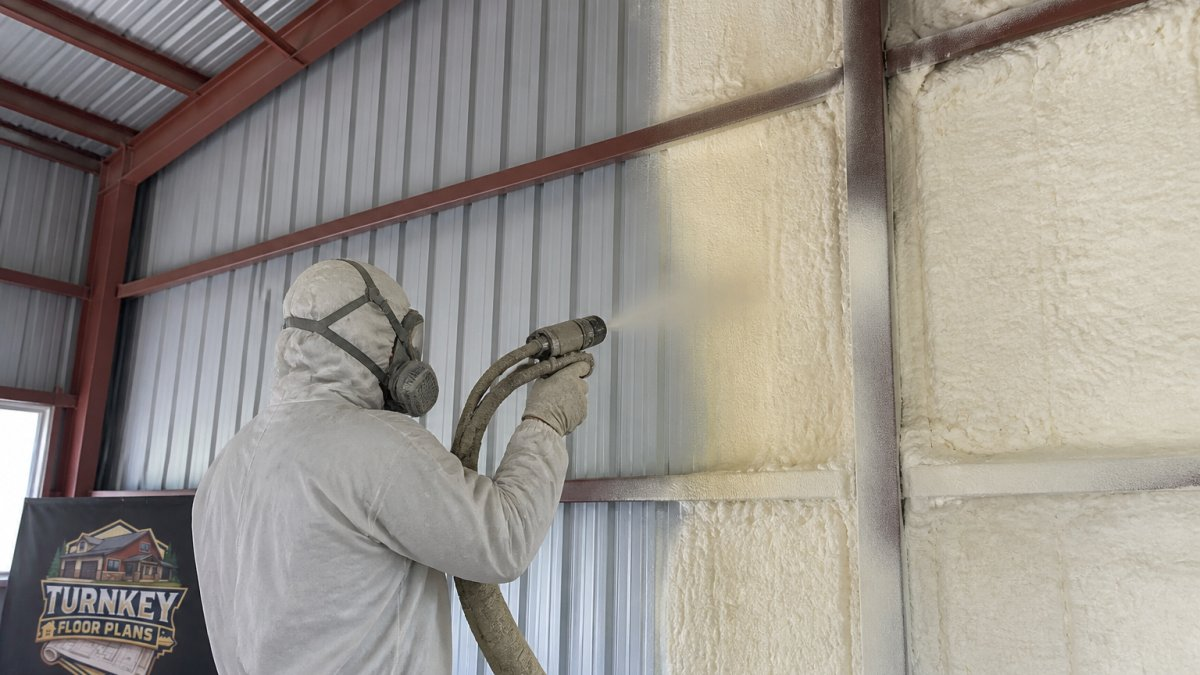
Closed-cell foam sprayed directly to the steel creates a vapor barrier that keeps interior moisture away from the cold panel surface. No gap, no condensation.
This is also where corrosion protection enters the picture. Wet steel corrodes. Keeping the panels dry extends the building lifespan and protects the structural members behind the finish.
Payback, Code, and Installation Quality: What Decides the Verdict
Three factors decide whether spray foam pays off in a metal home: how the upfront cost is recovered over time, whether the installation meets code, and whether the job was done well enough to perform as designed. Each one is testable, and each one is where projects go wrong.
How Payback Actually Works
Payback is the point where accumulated energy savings plus avoided moisture damage equal the premium you paid over batt insulation. The timeline depends on climate, energy prices, building use, and how leaky the alternative would have been.
A practical way to think about it: a tight, well-insulated envelope reduces heating and cooling load year after year, and it protects the steel from condensation-driven corrosion that shortens service life. Both are real returns, but neither is guaranteed by the product alone, they depend on installation quality and climate. Treat any payback figure you see online as a scenario, not a promise.
Code and Fire Safety: What to Confirm Before You Spray
Most building codes require an approved thermal barrier over foam plastic insulation in occupied spaces, and some assemblies require an ignition barrier instead. Requirements vary by occupancy, jurisdiction, and the specific foam product’s listing. Before you finalize an insulation plan:
- Confirm with your local building department which barrier applies to your occupancy and assembly.
- Ask the installer for the foam manufacturer’s product data and code evaluation report.
- Confirm whether the thermal barrier is included in the bid or a separate line item.
- Verify that the barrier product itself is rated for the application.
The U.S. Department of Energy insulation guidance is a useful starting point for climate-zone R-value targets, but it does not replace your local code official.
Installation Quality: A Pre-Signoff Checklist
A bad spray job is worse than no spray job. Off-ratio foam may never cure properly, and voids or thin spots defeat the air-sealing purpose. Before the crew leaves and before interior finishes go up, verify:
- Substrate condition, steel is clean, dry, and free of oil or rust that would prevent adhesion.
- Thickness, measured at multiple points against the specified total inches, not just eyeballed.
- Coverage, no voids, gaps at purlins and girts, or thin passes.
- Adhesion, foam is bonded to the steel, not sitting loose or delaminating.
- Color and cure, uniform color and firm cure indicate proper ratio; off-color or tacky foam is a red flag.
- Ventilation and off-gassing, the space was ventilated per the manufacturer’s instructions during and after application.
- Documentation, dated photos of coverage and thickness, plus the installer’s product and ratio records.
Photograph the foam before the interior finish goes up. If a warranty claim ever comes up, dated photos of proper coverage and thickness are the difference between a covered repair and an argument.
Once your insulation plan is set, browse barndominium floor plans through Turn Key Floorplans, where layouts account for wall thickness and interior finish so your insulation choice fits the design. Use code STOCKPLANSLUKE for 10% off eligible stock plans.
Frequently Asked Questions
What are the downsides of spray foam insulation?
The main downsides are upfront cost, the need for a specialized installer, and the fact that cured foam is difficult to remove if you need to run new wiring or fix a leak. Closed-cell foam costs more than open-cell, and both require proper protective equipment during application. Foam also needs a thermal barrier such as drywall in living areas to meet fire-safety requirements. In a metal building, poor surface preparation or the wrong foam density can lead to adhesion failures, so installation quality matters as much as the product itself.
Does spray foam insulation adhere to metal?
Yes. Properly applied spray foam bonds tightly to clean, dry steel panels, purlins, and girts, which is one reason it seals air leaks so effectively in a metal building. Adhesion depends on surface preparation: dust, oil, rust, or condensation on the panels can prevent a solid bond. Contractors typically clean and dry the surface before spraying and apply the foam in passes at the correct thickness. If the foam pulls away or feels soft after curing, that points to an application problem worth raising with the installer before the project moves on.
What does it cost to spray foam a metal building?
Your actual spray foam insulation cost for a metal building depends on square footage, foam type, and labor, so get a project-specific quote.
Can spray foam prevent condensation on a metal roof?
Spray foam helps more than most alternatives because it bonds directly to the underside of the roof panels, sealing the gaps where warm, moist interior air would otherwise meet cold steel and condense. Closed-cell foam also acts as a vapor retarder. That said, metal building condensation control is a system, not a single product: ventilation, interior humidity levels, and how the building is used all affect whether moisture forms. Foam reduces the risk substantially, but a building with heavy moisture sources still needs proper venting and moisture management.
Should you use a vapor barrier with spray foam in a metal building?
Usually not in the same way you would with fiberglass. Closed-cell spray foam performs as its own vapor retarder when applied at adequate thickness, so adding a separate interior vapor barrier can trap moisture between layers. With open-cell foam, a vapor-retarder coating or careful interior finishing may be needed depending on your climate. The right answer depends on your climate zone and building design, so confirm the assembly with your contractor or a local code official rather than defaulting to a barrier out of habit.
Insulating a metal home is one decision among dozens, and getting it wrong is expensive to fix. Turn Key Floorplans connects you with a network of general contractors who specialize in metal buildings and barndominiums, and our floor plan library helps you plan the interior finish around your insulation strategy. Get a free building quote from Turn Key Floorplans and start your project with pricing built around your actual plans, climate, and specifications.
Leave a Reply