Last Updated: October 26, 2026
Quick Summary
RV garage flooring is any hard-wearing surface installed over a concrete slab that can carry a loaded recreational vehicle, resist tire staining and chemical drips, and stay practical to clean. The five best options are epoxy, polyaspartic and polyurea coatings, interlocking tiles and rubber mats, sealed or polished concrete, and moisture-resistant vinyl or laminate.
- A loaded motorhome concentrates enormous weight on four small tire patches, and leveling jacks concentrate it further.
- Tape a plastic sheet to the slab for a day or two; condensation means vapor is pushing up from below.
- Epoxy forms a seamless surface with no joints for water to enter, but it can yellow under UV exposure.
- Polyaspartic coatings cure fast and stay UV stable, though they cost more and are less forgiving for first-time installers.
- Sealed or polished concrete has the lowest material cost of the five and nothing to peel, chip, or delaminate.
Table of Contents
- What the Best Flooring for a Garage with an RV Has to Handle
- RV Garage Floor Load Capacity: What Your Slab and Surface Must Carry
- 1. Epoxy Flooring for RV Garage Use: The Seamless Coating Option
- 2. Polyaspartic and Polyurea Coatings: Faster Curing, Better UV Stability
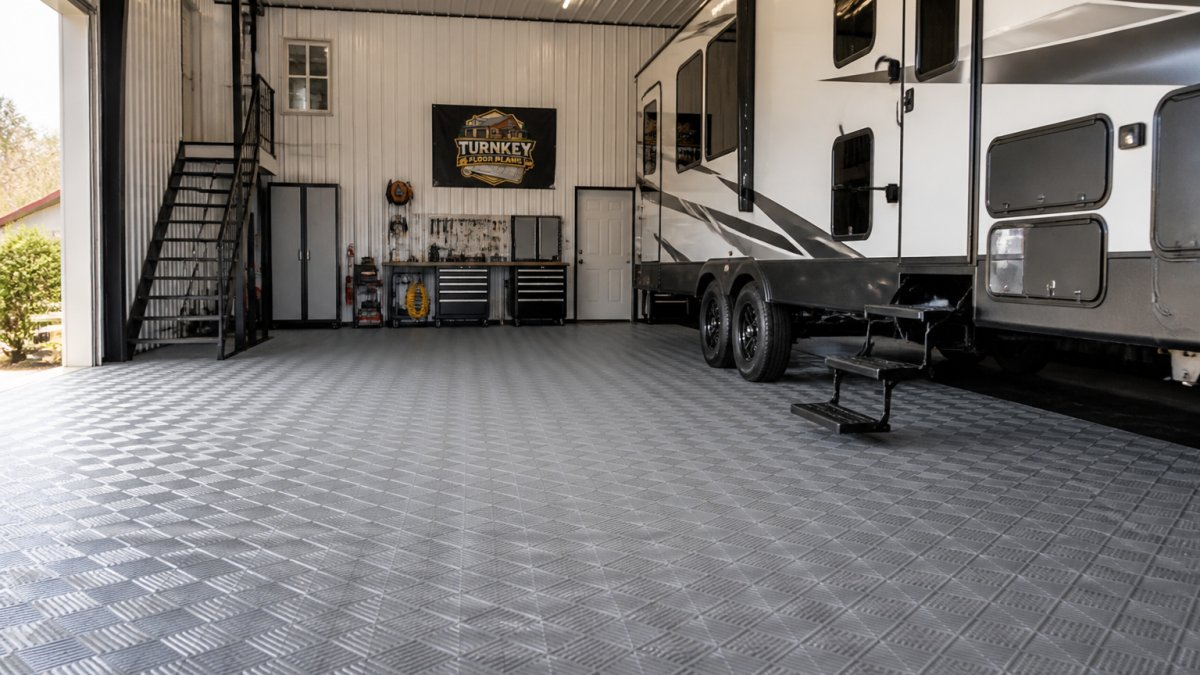
- 3. Interlocking Garage Floor Tiles and Rubber Mats: The Removable Route
- 4. Sealed or Polished Concrete: The Bare-Slab Baseline
- 5. Moisture-Resistant Garage Flooring: Vinyl Plank, Sheet Vinyl, and Laminate
- Comparing the Five Options: Lifecycle Cost, Maintenance, and Climate Fit
- Frequently Asked Questions
What the Best Flooring for a Garage with an RV Has to Handle
Picking RV garage flooring for a residential RV garage is not the same job as coating a workshop or finishing a basement. A motorhome or travel trailer parks a lot of weight on a small contact patch, and the surface underneath has to survive it.
Here is the core question. RV garage flooring is any hard-wearing surface installed over a concrete slab that can carry a loaded recreational vehicle, resist tire staining and chemical drips, and still be practical to clean and maintain. The five options below each answer that brief differently. Selecting the right material requires balancing these heavy-duty requirements against the versatility needed for other tasks, a trade-off that often leads homeowners to compare these garage flooring options with those suitable for home workshops.
Four things decide whether a floor holds up:
- Point loads from tires, leveling jacks, and stabilizers
- Hot-tire pickup, where warm rubber bonds to soft coatings and peels them
- Moisture moving through the slab from below
- Chemical exposure from oil, fuel, and holding-tank additives
If you are still settling the building layout itself, our guide to barndominium RV garage planning covers clear height, bay depth, and door sizing before flooring ever enters the picture.
RV Garage Floor Load Capacity: What Your Slab and Surface Must Carry
Load capacity is where most flooring decisions go wrong, because owners compare finishes by look instead of by what sits on them. This is also where most online guides stop short: they describe flooring inside an RV, not the slab a loaded RV parks on.
A loaded motorhome concentrates enormous weight on four small tire patches. Leveling jacks concentrate it further on contact points no bigger than a dinner plate. The concrete slab carries that load; the flooring is a wear layer on top. That distinction matters. No coating or tile adds structural strength to a slab that was poured too thin, cured poorly, or is already cracking.
What the surface must do:
- Spread impact without cracking, delaminating, or denting
- Stay bonded under stationary weight for weeks at a time
- Recover when a jack pad presses into it in summer heat
- Resist hot-tire pickup, where warm rubber bonds to a soft coating and peels it away
- Survive chemical exposure from oil, fuel, holding-tank additives, road salt, and de-icing brine
How tires and jacks actually load the floor
A tire does not press evenly. The contact patch is small, and the pressure inside it is far higher than the vehicle’s average weight per square foot. A leveling jack is worse: it puts a large share of the coach’s weight on a pad a few inches across. That is why a coating that looks fine under foot can crater under a jack in July, and why soft or flexible surfaces, rubber mats, thin vinyl, laminate, are the first to show damage.
Hard, well-bonded surfaces spread that concentrated load across the slab. Flexible surfaces absorb it, then recover slowly or not at all. That single mechanism explains most of the failures owners report.
Check the slab before you choose anything
Hairline cracks, dusting, and old oil stains all need attention first. A coating applied over a contaminated or damp slab will fail no matter how good the product is. A practical pre-installation checklist:
- Moisture test. Tape a plastic sheet to the slab for a day or two. Condensation under the sheet means vapor is pushing up from below, and a coating will blister.
- Contamination check. Old oil, grease, and tire dressing soak into concrete and prevent adhesion. Grinding or degreasing is usually required.
- Crack and spall survey. Structural cracks need repair before any wear layer goes down; cosmetic hairline cracks can be filled.
- Slab thickness and reinforcement. If the pour is thin or unreinforced, no finish will fix it, plan the slab correctly at build time.
Skipping a moisture test before installation is the single most common cause of coating failure. A simple plastic-sheet test taped to the slab for a day or two will tell you whether vapor is pushing up from below.
Climate and slab condition change the answer
Temperature swings and freeze-thaw exposure stress both the slab and the wear layer. In cold climates, de-icing salt and brine attack coatings and work into joints. In humid climates, moisture management under the slab matters more than the finish on top. In hot, sunny climates, UV exposure and hot-tire pickup push you toward harder, more heat-tolerant surfaces.
The takeaway: pick the flooring after you understand the slab, the loads, and the local climate, not before.
1. Epoxy Flooring for RV Garage Use: The Seamless Coating Option
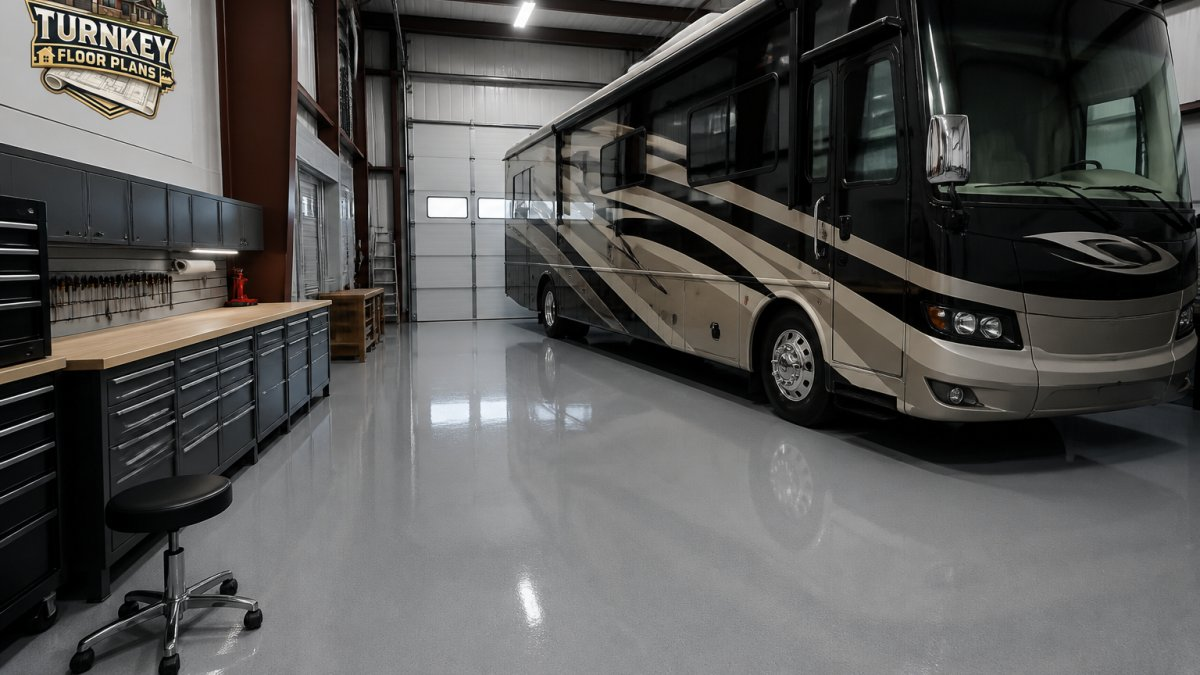
Epoxy bonds directly to prepared concrete and forms a seamless surface with no joints for water to enter.
Pros:
- Seamless surface, easy to sweep and hose down
- Strong chemical and stain resistance
- Customizable color and flake finishes
Cons:
- Cures slowly, so the garage stays empty for days
- Can yellow under UV exposure near open doors
- Slippery when wet unless an aggregate is added
2. Polyaspartic and Polyurea Coatings: Faster Curing, Better UV Stability
Pros:
- Fast cure, minimal downtime
- UV stable, so no yellowing
- Good adhesion and flexibility
Cons:
- Higher material cost than standard epoxy
- Less forgiving for a first-time installer
- Shorter working time once mixed
3. Interlocking Garage Floor Tiles and Rubber Mats: The Removable Route
Pros:
- No adhesive, no cure time, no downtime
- Removable and replaceable tile by tile
- Cushions dropped tools and improves slip resistance
Cons:
- Seams trap dirt and moisture
- Tiles can shift under heavy turning tires
- Higher long-term cost per square foot than coatings
4. Sealed or Polished Concrete: The Bare-Slab Baseline
Pros:
- Lowest material cost of the five
- Nothing to peel, chip, or delaminate
- Excellent wear resistance
Cons:
- Little protection against oil and chemical staining unless sealed
- Cold and hard underfoot
- Cracks in the slab remain visible
If the look appeals to you but you want more character, our guide to barndominium stained concrete floors covers stain types, planning tips, and layout choices before you build.
5. Moisture-Resistant Garage Flooring: Vinyl Plank, Sheet Vinyl, and Laminate
Luxury vinyl plank and sheet vinyl are genuinely water-resistant on the surface and comfortable underfoot. Laminate flooring is the weakest of the three in a garage setting, because most laminate cores swell if water reaches the edges.
Pros:
- Warm, comfortable surface
- Wide range of wood-look and stone-look finishes
- Easy to install as a floating floor
Cons:
- Seams let moisture in
- Point loads from jacks can dent or crack the wear layer
- Not designed for wet vehicles or chemical spills
Comparing the Five Options: Lifecycle Cost, Maintenance, and Climate Fit
| Option | Best For | Relative Installed Cost | Expected Service Life | Repairability | Maintenance | Watch Out For |
|---|---|---|---|---|---|---|
| Epoxy | Working garages, chemical resistance | Moderate | Long | Patchable, but color match is hard | Sweep and damp mop; recoat when worn | Slow cure, slick when wet, UV yellowing |
| Polyaspartic | UV-exposed doors, fast turnaround | Higher | Long | Patchable, fast cure helps | Sweep and damp mop | Higher material cost, short pot life |
| Interlocking tiles | Rentals, DIY installs | Moderate to higher over time | Long (replaceable) | Replace individual tiles | Lift and rinse tiles | Seams trap dirt, tiles shift under turning tires |
| Sealed or polished concrete | Budget builds, heavy wear | Lowest | Very long | Grind and reseal | Dust mop, reseal periodically | Stains without sealer, visible cracks |
| Vinyl and laminate | Conditioned RV bays | Low to moderate | Shorter in a garage | Replace planks or sheets | Damp mop | Seams, denting, swelling |
Lifecycle thinking changes the ranking
- Coatings (epoxy, polyaspartic) reward you with low maintenance and a seamless surface, but they demand a properly prepared slab and a cure window where the garage stays empty.
- Interlocking tiles win on repairability and portability, but seams collect grit and moisture, and heavy turning tires can pop connections.
- Sealed or polished concrete is the lowest-maintenance, longest-lived option, provided you reseal and accept that oil will stain an unsealed surface.
- Vinyl and laminate are comfortable and attractive but are the weakest under point loads and wet vehicles; reserve them for a finished, conditioned bay.
Climate fit
Climate decides a lot. In hot, sunny regions, UV stability pushes you toward polyaspartic. In humid areas, moisture management under the slab matters more than the finish on top. In cold climates, de-icing chemicals and freeze-thaw cycles favor hard, chemically resistant surfaces over soft ones.
Safety and accessibility
Once the floor is settled, the next question is usually budget for the whole structure. Our RV garage build cost guide walks through what drives the total, and when you are ready to price the building itself, you can request free metal building quotes from professionals with no obligation. You can also find a turn key general contractor through our directory.
Frequently Asked Questions
Can you put an epoxy coating on an RV garage floor?
Yes, epoxy is one of the most common choices for an RV garage floor, but the slab has to be ready for it. The concrete needs to be fully cured, usually 28 days or more, and free of oil, dust, and laitance. Moisture testing matters too, because trapped vapor can blister a coating from below. A primer and a slip-resistant topcoat help with hot-tire pickup, where warm tires stick to and peel softer coatings. Surface preparation, often diamond grinding, decides how long the floor lasts.
What flooring can support the weight of a motorhome?
Most garage flooring options handle the weight of a motorhome because the concrete slab carries the load, not the surface layer. What matters is point load from jacks, stabilizers, and kickstands, which concentrate force into small contact areas. Coatings, sealed concrete, and interlocking tiles all spread that force across the slab. Soft materials like carpet and thin laminate are the weak links, because they compress, indent, or crack under concentrated weight rather than transferring it down.
How do you protect an RV garage floor from moisture and road salt?
Start with a vapor barrier under the slab and a surface that resists water and chlorides. Epoxy, polyaspartic, and sealed concrete all block liquid water from soaking in, and they clean up with a hose and squeegee. Interlocking tiles let water drain through the gaps, so they need a slab that slopes to a drain. Rinse road salt off the floor after winter trips, because chlorides left sitting on concrete break down the surface over time.
Are interlocking garage floor tiles suitable for an RV?
They work well for an RV garage when the slab is sound and drains properly. Interlocking tiles and rubber mats are removable, so you can pull them up for cleaning or replace a damaged section without redoing the whole floor. They handle point loads better than carpet or laminate, and they hide cracks and stains in older concrete. The trade-off is that water and fine grit collect in the seams, so plan on lifting and rinsing them periodically.

Leave a Reply