Last Updated: November 12, 2026
Quick Summary
You can lower barndominium insurance premiums by documenting your construction type, asking for every discount in writing before you bind coverage, and comparing quotes on identical limits. Steel frames, metal roofing, monitored security systems, and bundling home and auto often earn credits, while a corrected underwriting classification can cut your rate without changing coverage.
- Carriers need construction details, replacement cost, occupancy, and code compliance before issuing a real quote.
- Ask your agent for the carrier’s full discount schedule in writing before you bind coverage.
- Get at least three quotes on the same coverage limits so comparisons are equal.
- A percentage wind or hail deductible can cost far more than the standard deductible after a storm.
- Send corrected construction details and photos in writing to appeal a misclassified quote.
Table of Contents
- Why Barndominium Insurance Premiums Run Higher Than You Expect
- Barndominium Insurance Requirements: What Carriers Need Before They Quote
- Barndominium Construction Features and Insurance: What Lowers Your Rate
- Barndominium Insurance Discounts Worth Asking For
- Your Barndominium Insurance Quote Checklist for Comparing Carriers
- Balancing a Higher Deductible Against Real Coverage Gaps
- Get a Free Building Quote Before You Shop for Coverage
- Frequently Asked Questions
Why Barndominium Insurance Premiums Run Higher Than You Expect
Learning how to lower barndominium insurance premiums starts with one hard truth: carriers do not price a metal building home like a standard house. The reason is often how underwriters read the risk rather than the steel itself.
Barndominium insurance is a policy that covers a steel-framed or post-frame home and its contents, often written on a modified homeowners form or a dwelling fire form. Carriers see a non-standard structure, a large open span, and sometimes a shop under the same roof.
That mix confuses automated quoting systems. A common mistake is accepting the first number without asking how the building was classified. For owners wondering how a home RV garage affects insurance premiums, that deeper article explains how specific features like an RV bay change underwriting and rates.
How Underwriting Views a Metal Building Home
Underwriting is the process a carrier uses to decide whether to insure a building and at what rate. Most barndominium files get flagged for three reasons:
- The structure does not fit standard replacement cost tools
- The shop or garage changes the occupancy type
- The roof and wall system is unfamiliar to the reviewer
None of those are deal-breakers. They are details that need documenting, and that is where most owners lose money.
Barndominium Insurance Requirements: What Carriers Need Before They Quote
Most carriers need four things before they will issue a real barndominium insurance quote: proof of construction type, an accurate replacement cost figure, a clear occupancy description, and confirmation the build meets local code. Missing any one of these usually produces a higher placeholder rate.
Here is what to gather:
- Construction details, steel frame, wood frame, or post-frame, plus roof and wall materials
- Square footage, living space and shop space counted separately
- Foundation type, slab, pier, or crawl space
- Occupancy, primary home, seasonal, or rental
- Permit and inspection records, proof the build was signed off
- Photos, exterior, roof, and mechanical systems
Building code compliance matters here. The International Code Council’s building code resources explain the standards many local inspectors adopt. A documented, inspected build is easier to underwrite than an unfinished one.
This is also where a clear plan pays off. Reviewing barndominium building permits and regulations before construction keeps the paperwork carriers ask for in one place.
Barndominium Construction Features and Insurance: What Lowers Your Rate
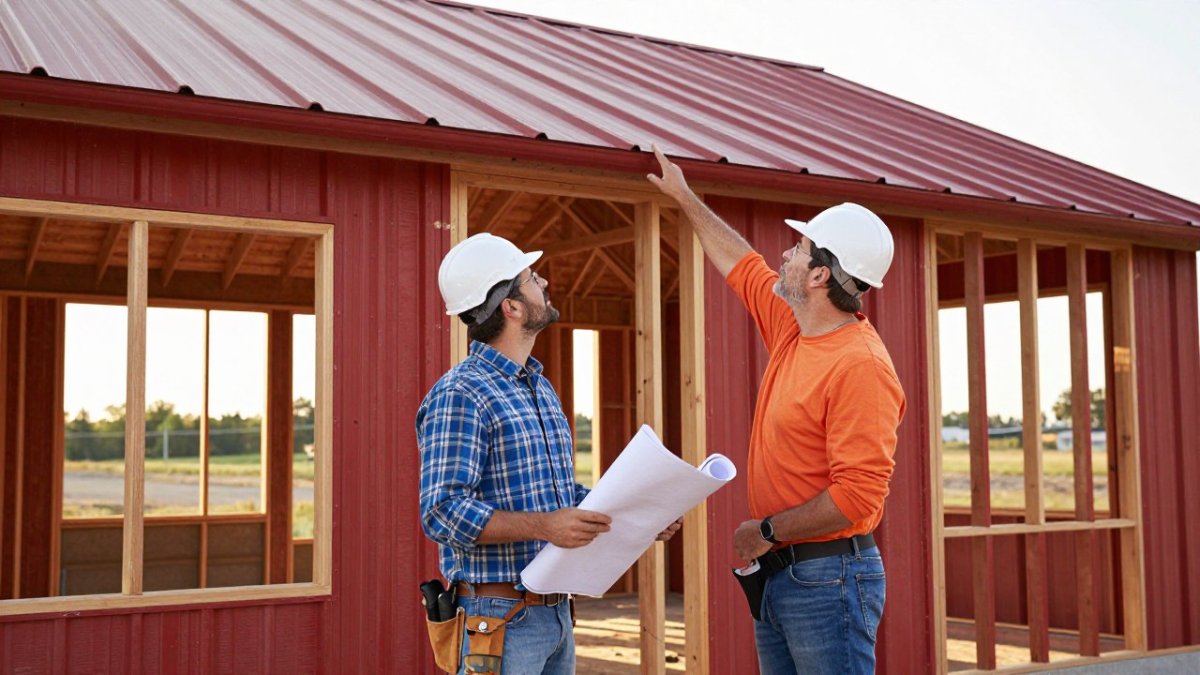
Construction features drive the rate more than anything else on the policy. Carriers price risk by how a building is built, not by how it looks.
Steel construction earns credit because it does not rot, warp, or feed fire the way exposed wood does. A red-iron frame with metal wall panels and a metal roof reads as low-maintenance and durable to most underwriters.
Wood paneling and combustible materials work the other way. They raise loss potential and often push a file into a more expensive class.
Roof, Framing, and Fire-Resistance Details That Matter
The roof is the single most inspected feature on a barndominium file. Metal roofing with a documented fire rating helps. So does a framing system a reviewer can identify from photos.
Comparing steel frame vs wood frame for residential barndominiums is worth doing early, because the structural choice shapes both the fire-resistance rating and the premium. A common mistake is finishing the interior before the carrier has seen the frame.
Barndominium Insurance Discounts Worth Asking For
Barndominium insurance discounts exist, but almost none are applied automatically. Owners have to ask, and they have to qualify. The most common credits fall into four groups, and each one has an eligibility requirement a carrier will verify.
| Discount | What It Usually Requires | How to Document It | Typical Effect |
|---|---|---|---|
| Monitored security system | Central-station monitoring under a written contract, burglar and often fire monitoring | Certificate or monitoring agreement from the alarm company | Small credit on most policies |
| Fire protection | Working smoke alarms, sometimes sprinklers, and a hydrant or water source within a set distance | Photos, inspection records, and the hydrant location | Varies widely by carrier |
| Policy bundling | Home and auto (or home and umbrella) with the same carrier | Declarations pages for both policies | Often the largest single credit |
| Higher deductible | Agreeing to pay more out of pocket per claim | Stated on the quote | Lowers annual premium, raises claim cost |
| Newer construction | Recent build with permit and inspection records | Certificate of occupancy and inspection sign-offs | Better risk class |
| Impact-resistant roof | Metal roof panels meeting a recognized impact rating | Manufacturer specification sheet | Credit where the carrier recognizes the rating |
| Claims-free history | No paid claims in the lookback period the carrier uses | Loss runs or a signed claims history | Preferred tier pricing |
A monitored security system and a home and auto bundle are the two easiest to secure. The question of whether spray foam insulation is worth it for metal homes is worth settling before the quote, not after.
How to Actually Claim a Discount
Each discount is an underwriting credit, and the carrier has to see proof before it applies. A practical sequence:
- Ask the agent for the carrier’s full discount schedule in writing before you bind coverage.
- Match each credit to the documentation the carrier accepts, such as a monitoring certificate, roof spec sheet, or inspection record.
- Submit the documents with the application rather than after the policy is issued.
- Confirm the credits appear as itemized line items on the declarations page.
Watch out: a discount that lowers the premium can also come with a condition, such as a required alarm contract or a minimum roof rating, and letting that condition lapse can void the credit or the claim.
Discounts Versus Coverage Trade-Offs
Not every discount is free money. A higher deductible and a claims-free credit both reward you for absorbing more risk, and a security discount may require an ongoing monitoring contract. Before stacking credits, ask what each one costs you in out-of-pocket exposure or recurring expense, and compare the net savings rather than the headline percentage. A credit that saves a little each year but leaves a large gap after a storm is not a real saving.
Your Barndominium Insurance Quote Checklist for Comparing Carriers
A barndominium insurance quote checklist keeps you from comparing apples to oranges. Cheap policies often look cheap because they leave something out. Use this list for every carrier:
- Dwelling coverage limit matches replacement cost, not market value
- Shop and garage space is included, not excluded
- Policy exclusions are listed in writing
- Deductible is stated, including any separate wind or hail deductible
- Loss of use and liability limits are shown
- Discounts applied are itemized
- Claims history is recorded correctly
- Annual premium is shown with any fees
Get at least three quotes on the same coverage limits. Comparing insurers only works when the limits match.
How to Appeal a Quote or Correct an Underwriting Classification
If a quote looks wrong, it often is. Underwriters classify buildings from limited data, and a misread file is common.
To appeal, send the carrier corrected construction details, photos, and inspection records in writing. Ask specifically that the construction type and occupancy be reclassified. Many owners find a corrected classification lowers the premium without changing coverage at all.
Balancing a Higher Deductible Against Real Coverage Gaps
Raising the deductible is the fastest way to cut an annual premium. It is also the fastest way to create an out-of-pocket surprise. The trade-off is simple: a higher deductible lowers the premium but raises what you pay when you file a claim. What most owners miss is that the deductible on a barndominium is often not one number.
The Deductible Is Usually Several Numbers
A barndominium policy can carry a standard all-peril deductible plus separate deductibles for wind, hail, and sometimes named storms. Those separate deductibles are frequently stated as a percentage of the dwelling limit rather than a flat dollar amount, which means the dollar figure moves with your coverage limit.
A common pattern is a flat all-peril deductible and a percentage wind or hail deductible. On a metal roof in a hail-prone region, that percentage deductible is the number that matters after a storm, and it can be far higher than the standard deductible. Ask the agent to state every deductible on the quote in dollars, not just percentages, so you can compare offers on equal footing.
A Transparent Comparison Example
The numbers below are illustrative only and do not represent any carrier’s actual rates. They show how to compare two offers beyond the headline premium.
| Offer A | Offer B | |
|---|---|---|
| Annual premium | Lower | Higher |
| All-peril deductible | Higher flat amount | Lower flat amount |
| Wind/hail deductible | Percentage of dwelling limit | Lower percentage or flat amount |
| Dwelling limit | Same | Same |
| Shop and garage included | Confirm in writing | Confirm in writing |
| Loss of use and liability | Confirm limits | Confirm limits |
Offer A looks cheaper until a hail claim arrives and the percentage wind deductible applies. The real comparison is premium plus the out-of-pocket you would face in a realistic claim, not the premium alone.
When a Higher Deductible Becomes Excessive Risk
A higher deductible is reasonable when you have a cash reserve large enough to cover it without borrowing. It becomes excessive risk when any of these are true:
- The deductible exceeds what you could pay comfortably after a major loss.
- The wind or hail deductible is a percentage that grows every time you raise the dwelling limit.
- You are relying on the policy to cover a total loss and could not rebuild with the deductible subtracted.
- The premium savings are small relative to the added exposure.
If a large out-of-pocket cost would strain the budget, keep the deductible lower and pursue discounts instead. The goal is a premium you can sustain without a coverage gap you could not survive.
Correcting a Misclassified Quote
If a quote looks wrong, it often is. Underwriters classify buildings from limited data, and a misread file is common. To appeal, send the carrier corrected construction details, photos, and inspection records in writing. Ask specifically that the construction type and occupancy be reclassified. Many owners find a corrected classification lowers the premium without changing coverage at all, which is a better outcome than raising the deductible to chase a lower number.
Get a Free Building Quote Before You Shop for Coverage
Accurate construction details are the foundation of every good barndominium insurance policy. Carriers price what they can verify. Owners who document the build, ask for discounts, and compare equivalent quotes consistently land better rates than those who take the first offer.
Turn Key Floorplans organizes customizable barndominium floor plans by bedroom count, square footage, and features like shop space or RV storage. It also connects owners with a network of general contractors who specialize in metal buildings and barndominiums.
Start with a free building quote to lock in accurate replacement-cost details, then shop carriers with confidence.
Insurance is easier to price when the building is planned well from day one. Turn Key Floorplans gives owners professional plan options, practical building tips, and connections to independent contractors who work in metal buildings. Browse plans, compare layouts, and get the details carriers will ask for. Get started with Turn Key Floorplans and build a file that underwriters can approve without guesswork.
Frequently Asked Questions
Is insurance high on a barndominium?
It can run higher than a comparable stick-built home, mainly because many carriers have no standard rate class for metal building homes and place them in a non-standard or specialty market. Barndominium insurance costs also depend on your state, wind and hail exposure, replacement cost, and whether the structure is code-compliant. The way to find out what you will actually pay is to gather several quotes built on identical coverage limits, then compare the annual premium and deductible side by side.
What construction features can affect barndominium insurance rates?
Underwriters look hardest at roof material and pitch, wall assembly, framing type, and fire protection. A standing-seam metal roof with a steep pitch sheds hail and snow better than a low-slope panel roof, and steel framing is generally viewed as less combustible than wood. Interior wood paneling, an attached shop with welding or fuel storage, and unheated square footage can all raise loss potential. Documenting these details for your agent before quoting prevents a carrier from assuming the worst.
Can a higher deductible lower my barndominium insurance premium?
Yes, raising your deductible is one of the fastest levers on an annual premium, but the trade-off is real out-of-pocket exposure. Before you switch, check what your savings would be against the extra cash you would need after a claim, and confirm your mortgage lender’s maximum allowed deductible. A deductible you cannot cover after a hailstorm is not a discount, it is a coverage gap you created yourself.
How should I compare barndominium insurance quotes?
Use a written checklist so every quote covers the same ground: dwelling coverage limit, replacement cost versus actual cash value, deductible, policy exclusions, whether the shop is included or excluded, and any wind or hail percentage deductible. Ask each carrier to confirm the construction type they classified you under. Comparing annual premiums alone hides the differences that decide whether a claim actually gets paid.

Leave a Reply